Ebbinghaus Forgetting Curve Explained: Definition & Uses
You practice a song until you can play it perfectly, then come back a week later and fumble through the first bar. That gap between "I had this" and "where did it go?" has a name, and it's been studied since 1885. The Ebbinghaus forgetting curve explained in simple terms is this: without reinforcement, your brain dumps roughly 70% of new information within 24 hours. It's not a flaw in your ability, it's how human memory works by default.
Hermann Ebbinghaus was the first psychologist to put hard numbers on memory decay, and his findings still shape how we think about learning over a century later. This article breaks down what the forgetting curve actually is, how Ebbinghaus discovered it, why it matters for anyone building practical skills, and, most importantly, what you can do about it. We'll cover the science, the math, and the proven strategies like spaced repetition that turn the curve in your favor.
That last part is exactly why we built MemoRep. Our platform applies the forgetting curve research directly to practice scheduling, so musicians and skill learners know what to revisit and when, right before a skill starts to fade. But before we get into tools, let's start with the science that makes them work.
What the Ebbinghaus forgetting curve is
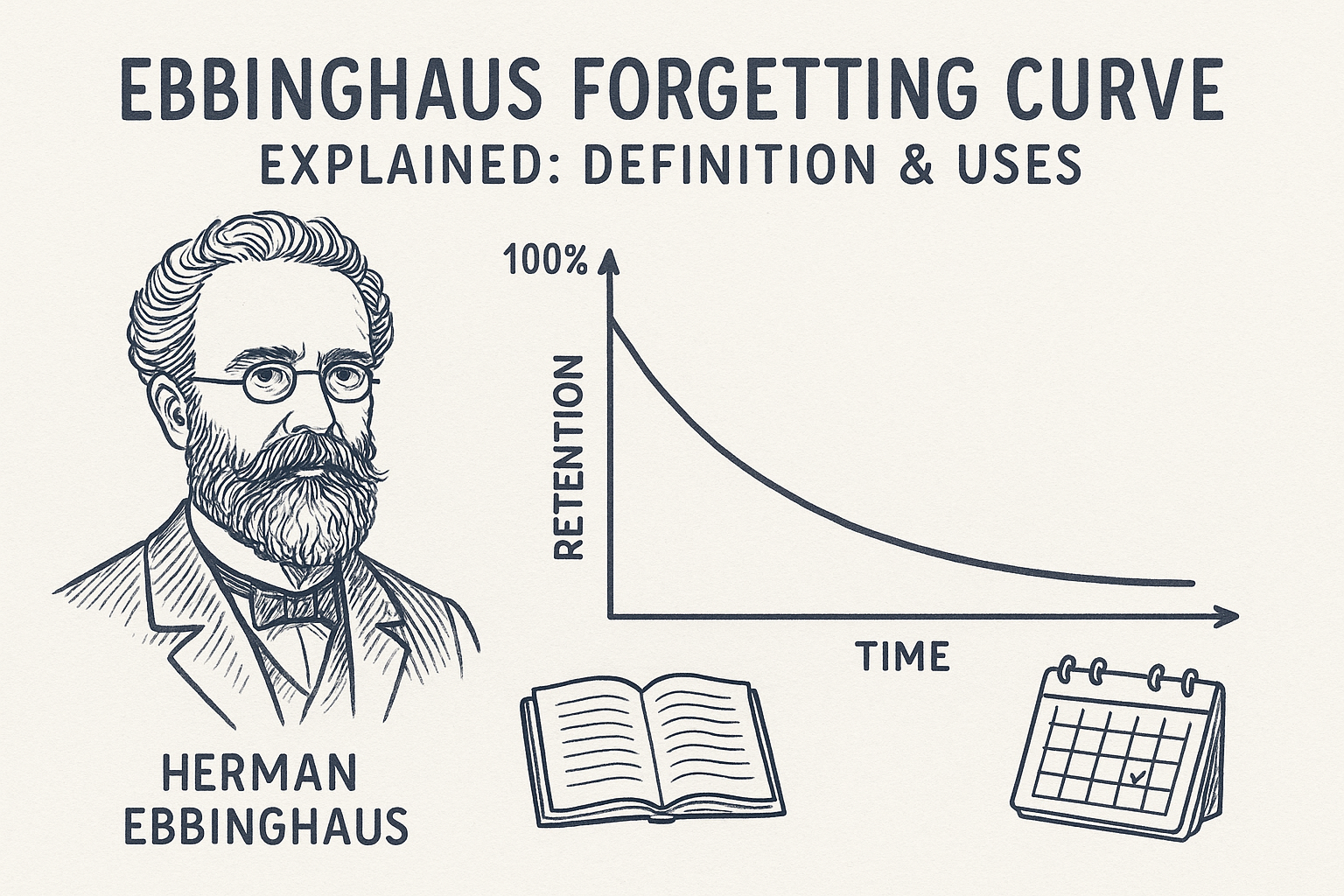
The Ebbinghaus forgetting curve is a mathematical model that describes how memory retention drops over time when you make no effort to review what you've learned. The curve plots retention percentage on the vertical axis against elapsed time on the horizontal axis, and it falls sharply in the first few hours after initial learning before gradually leveling off toward a low baseline. The critical insight is that forgetting is not random or chaotic. It follows a predictable, measurable trajectory, which means you can plan around it rather than fight it blindly.
The curve doesn't mean your brain is defective. It means forgetting is a built-in feature of memory consolidation, and because it's predictable, it's also workable.
The math behind the curve
Ebbinghaus expressed memory retention with the formula R = e^(-t/S), where R represents retrievability (the likelihood that you can recall something at a given moment), t is the time elapsed since learning, and S is the stability of the memory. You don't need to run this calculation yourself, but knowing what it captures is useful. The formula confirms that retention decays exponentially, which means the steepest drop happens in the hours immediately after learning, not gradually over days or weeks. Most of the damage is done before you even realize it.
The variable S is where this model gets genuinely useful. A higher stability value means the memory is more deeply encoded, so the curve flattens and decays more slowly over time. A lower S value produces a steep, fast drop. This explains why two people can study the same material in the same session and forget it at completely different speeds. Their prior knowledge, emotional engagement with the content, and existing practice history all push the S value up or down, changing the shape of their individual forgetting curve.
What the curve looks like in practice
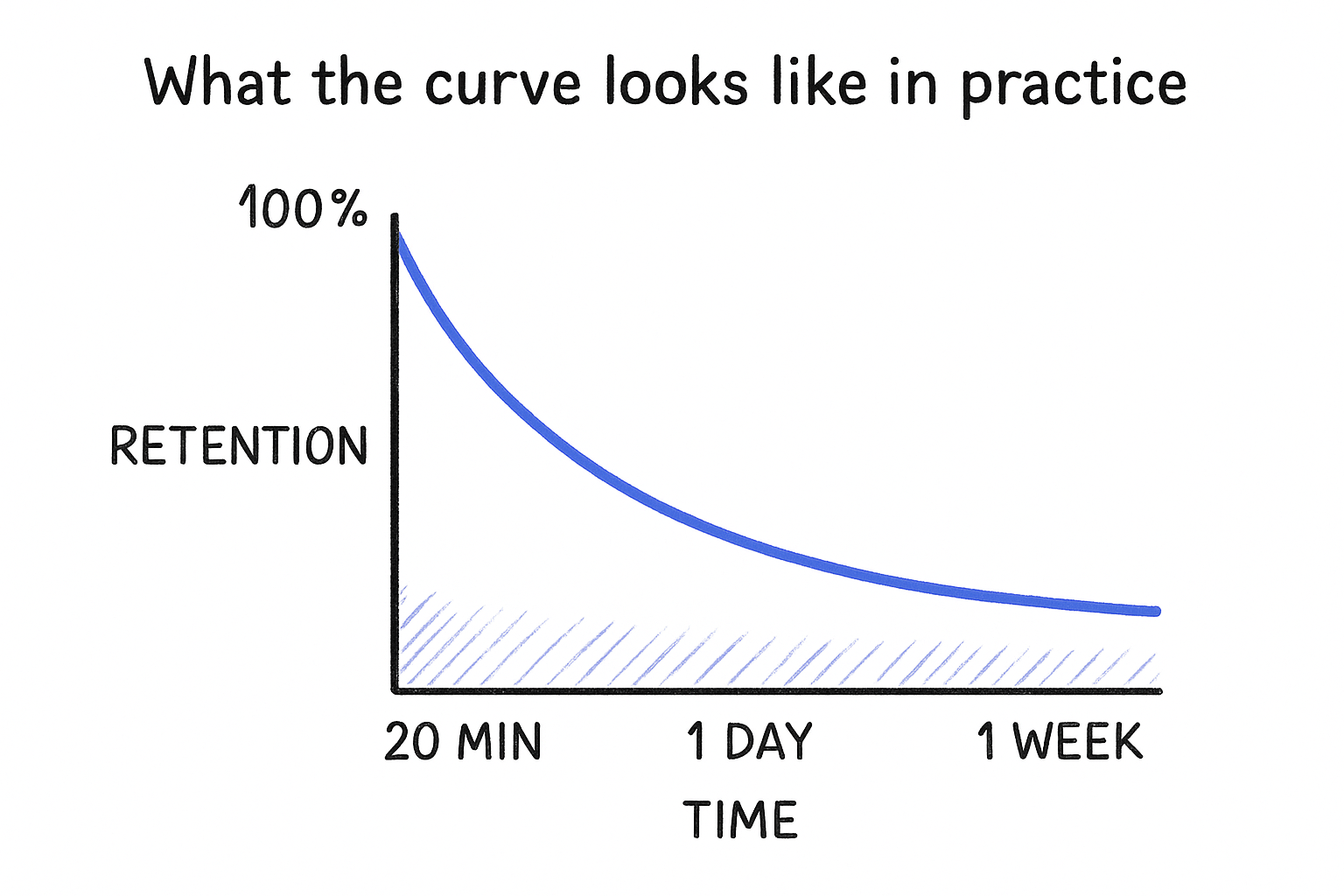
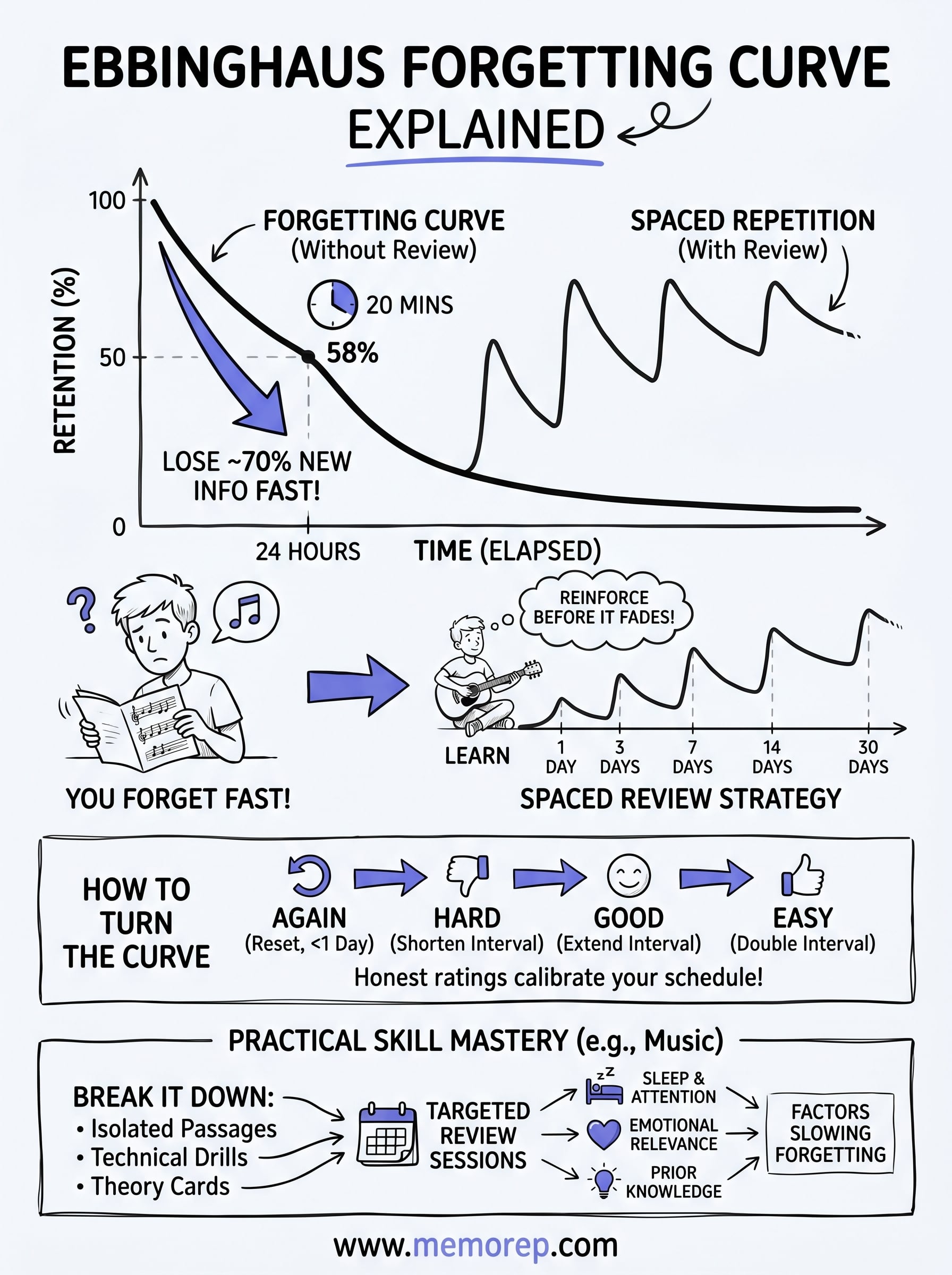
When you have the ebbinghaus forgetting curve explained in concrete numbers, the pattern is hard to ignore. Without any review, most people retain close to 100% of new information immediately after learning, but retention falls to around 58% within just 20 minutes. By the end of the first day, it typically sits between 33% and 44%. After a week without review, you're often working with less than 25% of the original material. The curve does level off near the bottom rather than dropping to zero, but that floor offers little comfort when the information you need is mostly gone.
For practical skills like playing a musical passage or drilling a technical movement, this decay pattern shows up in a specific way. You might retain the general concept of a technique even after two weeks away from it, but motor memory and execution accuracy erode on a curve very similar to fact-based recall. If you learned a chord transition 10 days ago and haven't practiced it since, the mental outline is still faintly there, but the physical coordination has degraded. The forgetting curve applies to both declarative memory (knowing that something is true) and procedural memory (knowing how to do something physically), which is exactly why it matters so much for musicians and anyone building hands-on skills.
Understanding the curve at this level shifts how you think about practice. Instead of asking yourself whether you remember something, you start asking when you'll forget it and whether you'll review it before that happens.
Where the idea came from and what Ebbinghaus tested
Hermann Ebbinghaus was a German psychologist working in the late 19th century who became obsessed with a question no one had seriously studied before: can memory be measured scientifically? At the time, memory research was largely philosophical. Ebbinghaus decided to treat it like a physics experiment, and the work he published in his 1885 book Über das Gedächtnis ("On Memory") gave the world its first data-driven look at how retention decays over time.
A scientist who used himself as the subject
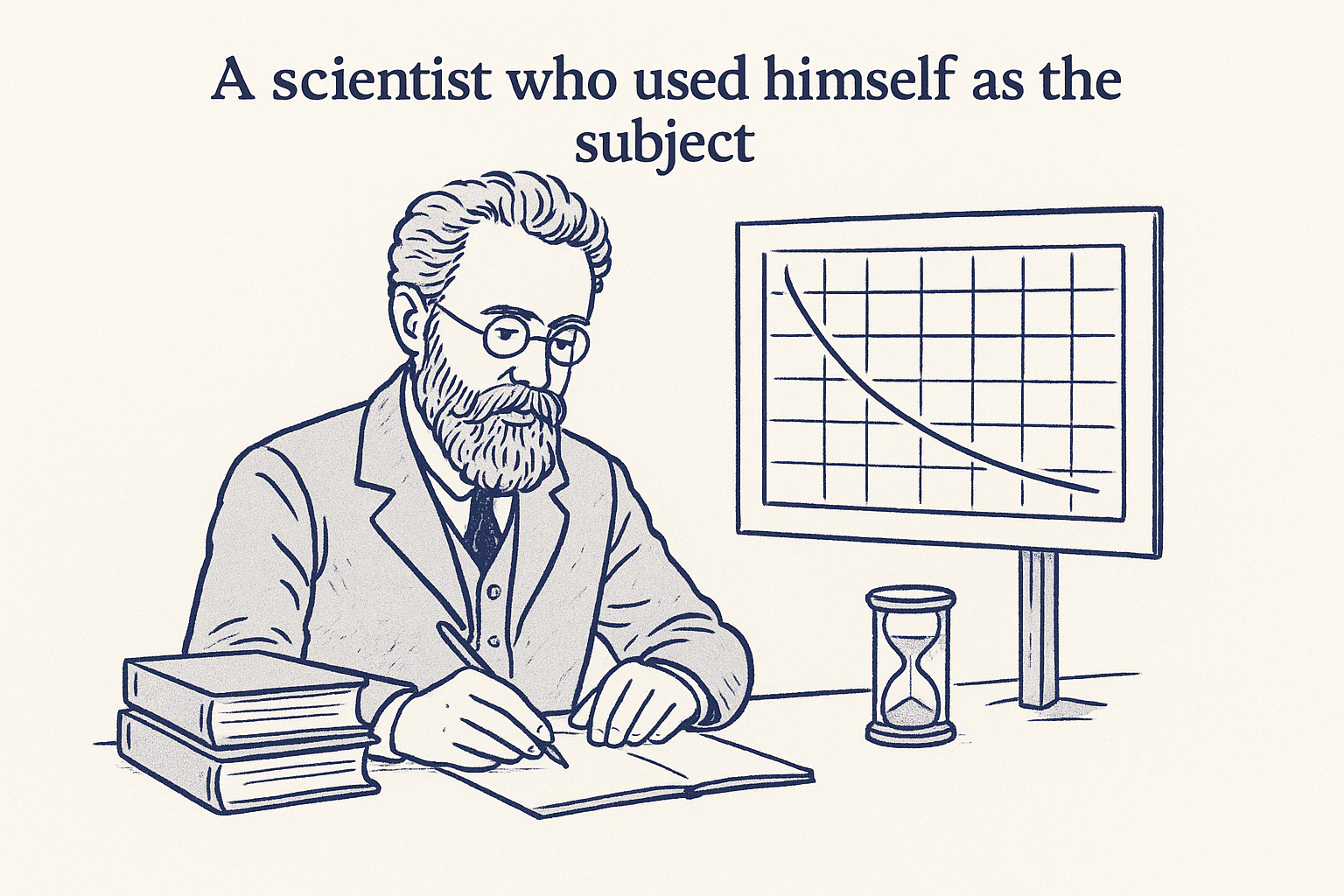
What makes Ebbinghaus unusual is that he ran almost every experiment on himself. Over several years, he memorized thousands of lists of nonsense syllables, meaningless two-consonant-plus-vowel combinations like "DAX," "BUP," and "ZOL," and then tested how well he could recall them at different time intervals. He chose nonsense syllables deliberately. By stripping out any existing meaning or emotional association, he could isolate the pure mechanics of memory formation and decay without interference from prior knowledge.
This design decision is why his findings have held up so well: by removing meaning from the material, he eliminated a major confounding variable that plagues most memory research.
His method for measuring retention was called the savings method. Rather than simply asking whether he could recall a list, he measured how much less time it took to relearn the same list after a delay compared to the original learning session. If a list originally took 10 repetitions to memorize and only required 6 repetitions after a break, he calculated a savings score of 40%. This approach was more sensitive than simple recall testing and captured partial retention that a pass-or-fail test would miss entirely.
What his results showed
Ebbinghaus tested himself across intervals ranging from 20 minutes to 31 days after initial learning. The pattern that emerged was consistent every time: retention dropped fastest in the first hour and then slowed significantly over the following days. His data revealed that the decay was not linear but exponential, which is why the result gets called a curve and not a line. With the ebbinghaus forgetting curve explained through his raw savings scores, later researchers could build the mathematical model that describes retention as a function of time and memory stability. His numbers from the 1880s still match closely with what modern neuroscience measures using brain imaging and more sophisticated testing tools.
How to read the curve and what it actually predicts
When you look at a chart of the forgetting curve, the shape itself tells the story. The vertical axis shows retention percentage (how much of the original material you can still recall), and the horizontal axis shows elapsed time since learning. The line starts at or near 100% on the left and drops steeply within the first hour, then continues to fall at a slower rate over the following days and weeks. Reading the curve correctly means understanding that the steepest risk period is the first few hours after you learn something new, not some vague point in the future.
What the two axes actually measure
The retention percentage on the vertical axis is not about whether you can recall something perfectly or not at all. Partial retention counts, which is why Ebbinghaus used his savings method rather than a simple pass-or-fail recall test. A score of 40% retention doesn't mean you've forgotten 60% completely; it means relearning the material takes 60% as long as the original session did. This distinction matters practically because it explains why skills feel harder to rebuild than to learn initially, even when some trace of the memory survives.
Forgetting happens on a compressed timescale at the very start, with the bulk of the drop occurring in the first 20 to 60 minutes. After that, the rate of loss slows significantly. By day 6 or 7, retention has largely stabilized at whatever low baseline remains without any reinforcement.
This is the part of the ebbinghaus forgetting curve explained that most people find counterintuitive: the longer you wait to review, the less time it saves you, because there's simply less left to save.
What the curve actually predicts
The curve predicts two things you can act on directly. First, it tells you when a memory is most vulnerable, which is the window immediately after initial learning. Second, it tells you how much you can expect to retain at a given point if no review happens in between. These predictions are averages drawn from Ebbinghaus's own data, but the general shape holds across most learners and most types of material.
What the curve does not predict is a fixed expiration date on your skills. A stronger initial encoding shifts the entire curve, flattening the drop and pushing the retention baseline higher. That means how you practice in the first session directly changes the shape of the curve you'll face later, which gives you real leverage over how fast forgetting sets in.
What speeds up or slows down forgetting
The forgetting curve is not a fixed sentence. Several specific factors shift how steep or shallow your personal curve turns out to be, and most of them are within your control. Understanding the ebbinghaus forgetting curve explained through the lens of these variables shows you exactly where to put your effort to slow down memory decay before it starts.
Factors that accelerate forgetting
Sleep deprivation is one of the fastest ways to steepen your curve. During sleep, your brain consolidates new memories by replaying neural activity from the day's learning sessions. Cut that window short and the memory consolidation process gets interrupted before it finishes, leaving freshly encoded skills in a fragile state that decays rapidly.
Stress and cognitive overload push forgetting in the same direction. When your working memory is stretched across too many competing demands, new information gets encoded shallowly. A shallow initial encoding means a lower stability value in the forgetting curve formula, which produces a steeper, faster drop in retention.
Factors that slow forgetting down
Emotional relevance is one of the strongest stabilizers of memory. When material connects to something you already care about or links to an existing goal, your brain assigns it higher priority during consolidation. For a musician, practicing a passage from a piece you genuinely want to perform will stick longer than drilling an abstract exercise with no personal investment attached to it.
Prior knowledge also acts as a buffer against rapid forgetting. If you already have a solid foundation in a topic or skill, new information has more existing structure to attach to, which raises the stability value and flattens the curve. This is why intermediate learners often retain new techniques faster than beginners working through the exact same material.
The single most reliable way to slow forgetting is to make the initial encoding deeper, not simply longer. A focused 15-minute session with full attention beats an hour of distracted repetition every time.
Sleep, attention quality, and prior knowledge are the three levers you control most directly. Protect your sleep after a practice session, minimize distractions during learning, and connect new material to skills you already own. Each of those choices raises the stability floor and gives your future reviews more to work with when the time comes.
What the curve gets wrong and common myths
The Ebbinghaus forgetting curve explained through his original research has a significant limitation built into it: Ebbinghaus tested only himself, using meaningless nonsense syllables under controlled conditions that bear little resemblance to real-world learning. The findings are a powerful starting point, but treating them as universal law creates several misconceptions that can actively undermine how you structure your practice.
The 70% rule is not a fixed number
The widely repeated claim that you forget 70% of information within 24 hours comes directly from Ebbinghaus's specific experiments with nonsense syllables. Meaningful material, like a chord progression tied to a song you genuinely want to perform or a technique connected to a clear musical goal, decays significantly slower. Your personal forgetting curve is shaped by your emotional investment in the material, the prior knowledge you bring to the session, and how deeply you encoded the skill during initial learning. The 70% figure describes the worst-case scenario for stripped-down, context-free material, not a prediction of how you'll retain everything you practice.
The curve does not describe a single universal slope
Many people assume the forgetting curve looks identical for everyone and for every type of material. That assumption is incorrect. Procedural memory (physical skills like playing a scale or executing a fingerpicking pattern) decays on a different timeline than declarative memory (knowing facts or theory definitions). Research since Ebbinghaus has confirmed that motor skills often retain a higher baseline over time compared to verbal recall, even when the gap between sessions is the same. Your curve for a practiced guitar technique will look noticeably flatter than your curve for a list of music theory terms studied once without application.
The takeaway is not that the forgetting curve is unreliable. It's that the curve describes a range, and the choices you make during initial learning determine where within that range your retention actually lands.
Reviewing once does not fully reset the clock
Another common myth is that a single review session restores your retention to 100% and restarts the forgetting timer from scratch. Reviewing does raise retention and strengthens memory stability, but the consolidation effect is proportional to how much you still retain at the moment of review. A review done when retention sits at 10% produces weaker re-encoding than a review done at 60%. This is exactly why the timing of your reviews carries more weight than the simple act of reviewing at all.
Why spaced repetition works against forgetting
Spaced repetition directly counters the mechanism that the Ebbinghaus forgetting curve explained reveals: memory decay is steepest immediately after learning and then slows down over time. Instead of massing all your practice into one block and hoping it sticks, spaced repetition places review sessions at the exact points where retention starts to drop, catching the skill before it fades to the point where relearning costs more time than the original session did.
How each review raises the stability floor
Every time you successfully retrieve a skill at the right moment, your brain doesn't just reset the clock. It actually re-encodes the memory at a deeper level, raising the stability value in the forgetting curve formula. A higher stability value means the next decay cycle is slower and shallower than the previous one. After several spaced reviews, the same skill that dropped to 30% retention within a week now holds above 80% for a month or more with no additional practice in between.
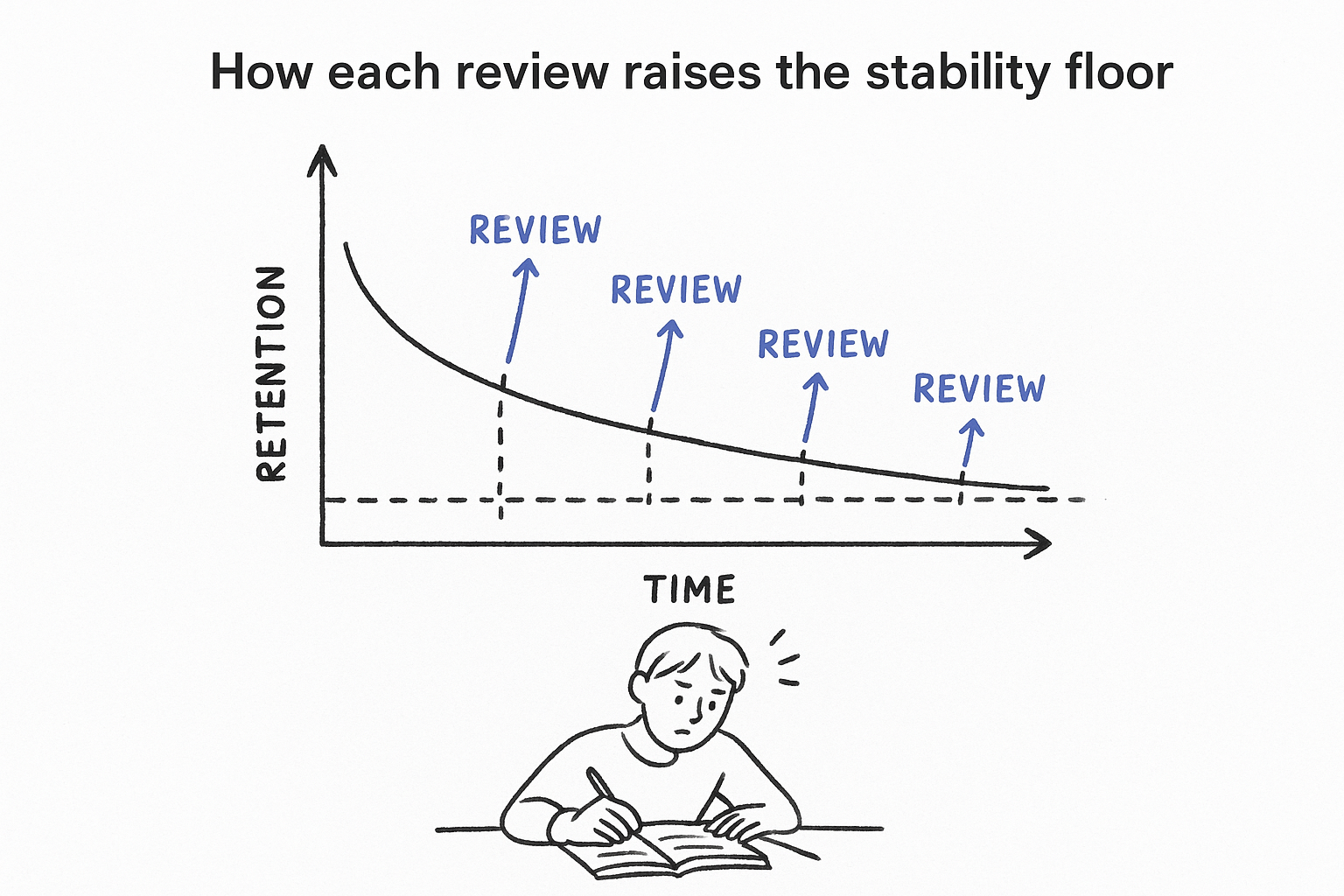
This is the compounding advantage that distinguishes spaced repetition from simple repetition. Repeating something 10 times in one sitting produces a modest and short-lived improvement in stability, while spacing 4 reviews across the natural decay points of the same skill produces a stronger, longer-lasting retention gain for less total time invested.
Retrieval itself is the mechanism, not passive re-exposure. The act of pulling a skill back from near-forgetting strengthens it more than reviewing it while it's still fresh.
Why the timing of reviews matters more than the quantity
Reviewing a skill when retention is still near 100% produces almost no stability gain because your brain treats it as unnecessary reinforcement. The real benefit kicks in when you review at the point where retention has dropped enough that retrieval requires genuine effort. That effort is called desirable difficulty, and research in cognitive science consistently shows it is the condition under which memory consolidation strengthens the most.
Spaced repetition systems calculate that timing for you by tracking how you performed on the last review and adjusting the next interval accordingly. If you rated a skill as difficult, the system shortens the gap. If you rated it as easy, it extends the interval, trusting that the stability is high enough to coast a little longer. The result is a personalized review schedule that keeps every skill inside your active retention window without wasting sessions on material that doesn't need reinforcement yet.
How to build a review schedule that sticks
Building a review schedule starts with accepting one fact: when you review matters more than how often you review. A schedule that places every skill on a fixed weekly cadence ignores the core insight the Ebbinghaus forgetting curve explained through Ebbinghaus's original data: different skills decay at different rates, and a one-size-fits-all interval wastes time on strong memories while letting weaker ones slip through the critical review window.
Start with your current retention, not a blank calendar
Your first review should happen within 24 hours of the initial session, while retention still sits high enough that retrieval requires some effort but not total reconstruction. After that first review, push the next one to 3 days out, then 7 days, then 14, then 30. This interval pattern is not arbitrary. Each gap is designed to catch the skill at the natural low point of its decay cycle, right before it crosses the threshold where relearning costs more time than reviewing does.
Reviewing too early is wasteful. Reviewing too late forces full relearning. The goal is to review at the exact point where retrieval requires enough effort to deepen consolidation, but not so much that the memory is essentially gone.
Here is a simple starting schedule you can apply immediately:
| Review | Interval after previous session |
|---|---|
| 1st review | 1 day |
| 2nd review | 3 days |
| 3rd review | 7 days |
| 4th review | 14 days |
| 5th review | 30 days |
Adjust intervals based on how the review goes
A static schedule only works as a starting point. Your actual performance during each review session should drive every adjustment you make. If a skill comes back quickly and feels solid, extend the next interval by 50% or more. If you struggle to retrieve it or make consistent errors, shorten the gap back to 1 or 2 days and rebuild from there.
Tracking this manually is possible but adds overhead that quickly becomes its own burden. A spaced repetition tool handles the interval math automatically, letting you focus on the practice itself rather than the scheduling logic behind it. The schedule only sticks when the system maintaining it is simple enough that you actually use it every session.
How to apply it to music and other practical skills
The ebbinghaus forgetting curve explained through academic examples can feel abstract until you connect it to something you actually practice. For musicians, the curve appears every time you return to a piece after a gap and discover your fingers no longer know where to go. The same pattern shows up in any practical skill that depends on physical execution: martial arts forms, athletic techniques, or even surgical procedures. The forgetting curve does not care what you're practicing. It only responds to how often you return to it.
Break skills into small, reviewable units
The most common mistake musicians make is treating an entire song or piece as a single unit of practice. When you schedule a review, you schedule the whole song, which means you spend most of your session on the parts that held up fine and neglect the bars that actually decayed. Breaking your practice into isolated segments solves this directly. Each passage, technique, or exercise becomes its own item in your review schedule, with its own decay timeline and its own interval that adjusts based on how that specific section performed.
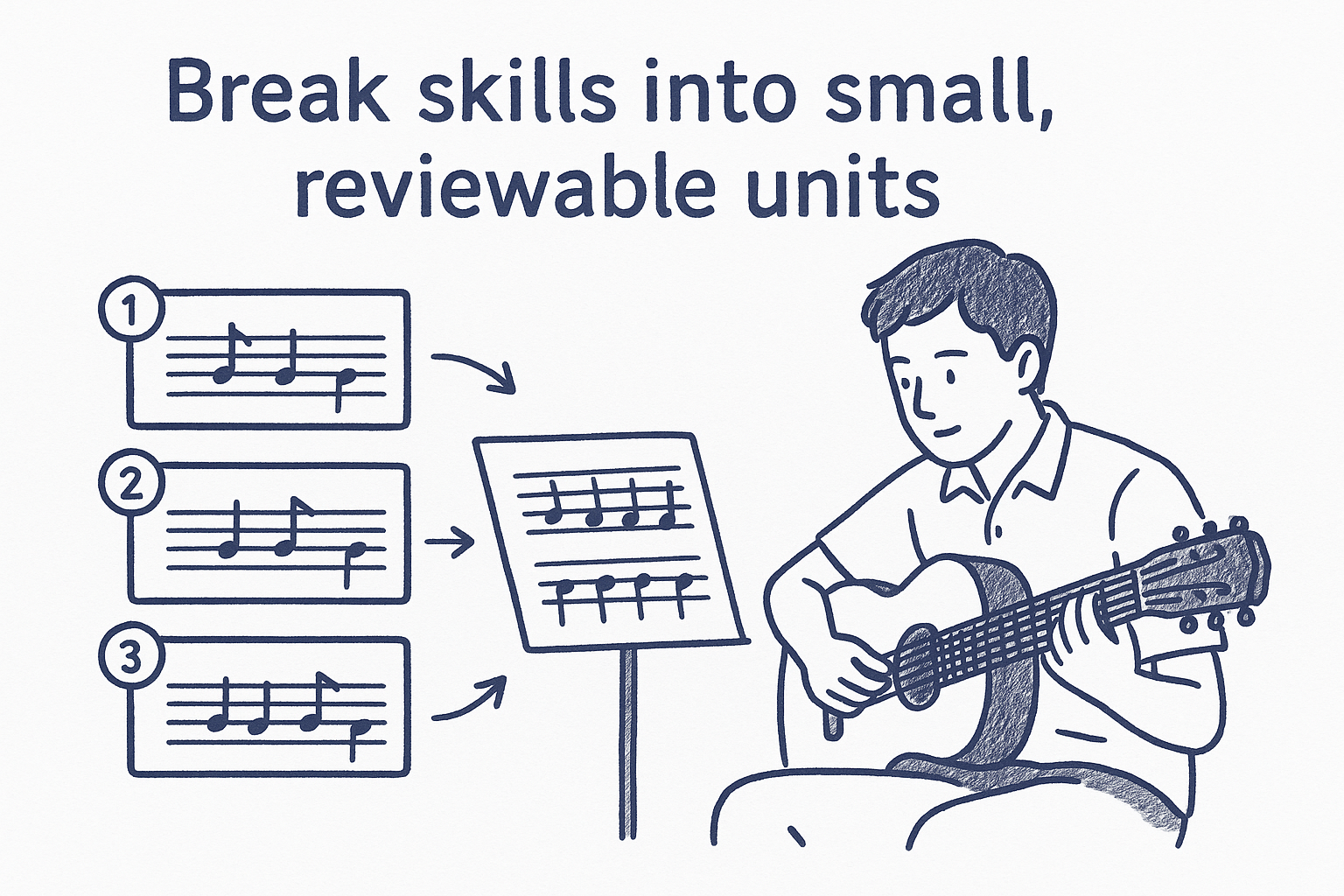
This approach scales beyond music without any modification. A martial artist can isolate individual techniques or combinations rather than running through an entire form every session. A gymnast can target specific skills within a routine. The logic stays the same: smaller units give you precise control over which parts of your skill set get reinforcement and exactly when they need it.
The smaller and more specific the unit you're tracking, the more accurately your review schedule reflects what actually needs attention rather than what feels familiar.
Treat technical execution separately from music theory
Technical execution and theoretical knowledge follow different decay curves, which means they deserve separate treatment in your schedule. Playing a chord transition cleanly involves motor memory and physical coordination, while understanding why that chord works harmonically involves declarative knowledge. Both are useful, but motor memory typically holds its baseline longer than purely verbal recall, meaning theory concepts may need shorter initial review intervals than technical drills.
When you log your practice sessions, separating these two categories lets you assign intervals that match the actual decay rate for each type of content. Theory cards can be reviewed more frequently when new, while well-grooved technical passages earn longer gaps once they stabilize, without forcing you to treat every skill as identical.
How to use ratings like Again, Hard, Good, Easy
When a spaced repetition system asks you to rate a session after you finish practicing, it's not asking for a mood check. Those four ratings, Again, Hard, Good, and Easy, are the direct input that drives your entire review schedule. Each one tells the algorithm something specific about where your memory stability sits right now, and the system uses that signal to calculate how many days to wait before it brings that skill back to you. Getting comfortable with this feedback loop is what separates a review schedule that keeps compounding from one that slowly drifts out of sync with your actual retention.
What each rating actually means
Each rating maps to a specific retention signal, and understanding that mapping helps you apply them consistently rather than guessing each time.
| Rating | What it signals | Typical outcome |
|---|---|---|
| Again | You couldn't retrieve the skill or made significant errors | Interval resets to 1 day or less |
| Hard | You retrieved it but with real difficulty or hesitation | Interval shortens from the current gap |
| Good | You retrieved it with moderate effort, about what was expected | Interval extends at the standard multiplier |
| Easy | You retrieved it with no effort, it felt fully automatic | Interval extends aggressively, sometimes doubling |
The Again and Hard options are the ones most learners avoid because they feel like admissions of failure. They're not. They're the most important ratings in the system because they catch decay before it becomes full loss.
How honest ratings protect your schedule
The ebbinghaus forgetting curve explained through actual data makes this point clearly: reviewing a skill while retention is already very low forces near-complete relearning, which costs far more time than a shorter interval would have. If you rate something Good when it honestly deserved a Hard, you push the next review out further than your actual memory stability supports. The skill then arrives at that future session in worse shape, requiring even more recovery time.
Rating too generously doesn't save you practice time. It moves the cost forward and makes it larger when it arrives.
Consistent, honest ratings over several review cycles also give the algorithm accurate data about your personal decay rate for each specific skill. A technique you've owned for years will naturally earn more Easy ratings and build longer intervals. A newly learned passage will stay on shorter cycles until the stability confirms it's ready to stretch. That calibration is how a well-used rating system eventually learns the shape of your forgetting curve and schedules around it precisely.
Key takeaways and next steps
The ebbinghaus forgetting curve explained through Ebbinghaus's original research comes down to one actionable truth: forgetting follows a predictable, exponential pattern, and that predictability gives you real leverage over your retention. Memory drops fastest in the first 24 hours, spaced reviews at the right intervals rebuild stability more efficiently than massed practice, and honest session ratings keep your schedule calibrated to your actual decay rate. The curve is not a sentence. It's a system you can work with directly.
Any skill that needs to stay sharp, whether a musical passage, a technical drill, or a physical technique, responds to the same logic. Placing reviews at the natural low points of your forgetting curve compresses the total time you spend relearning and builds retention that holds across longer gaps. Start scheduling your practice with MemoRep and let the algorithm handle the timing while you focus on the skill itself.