
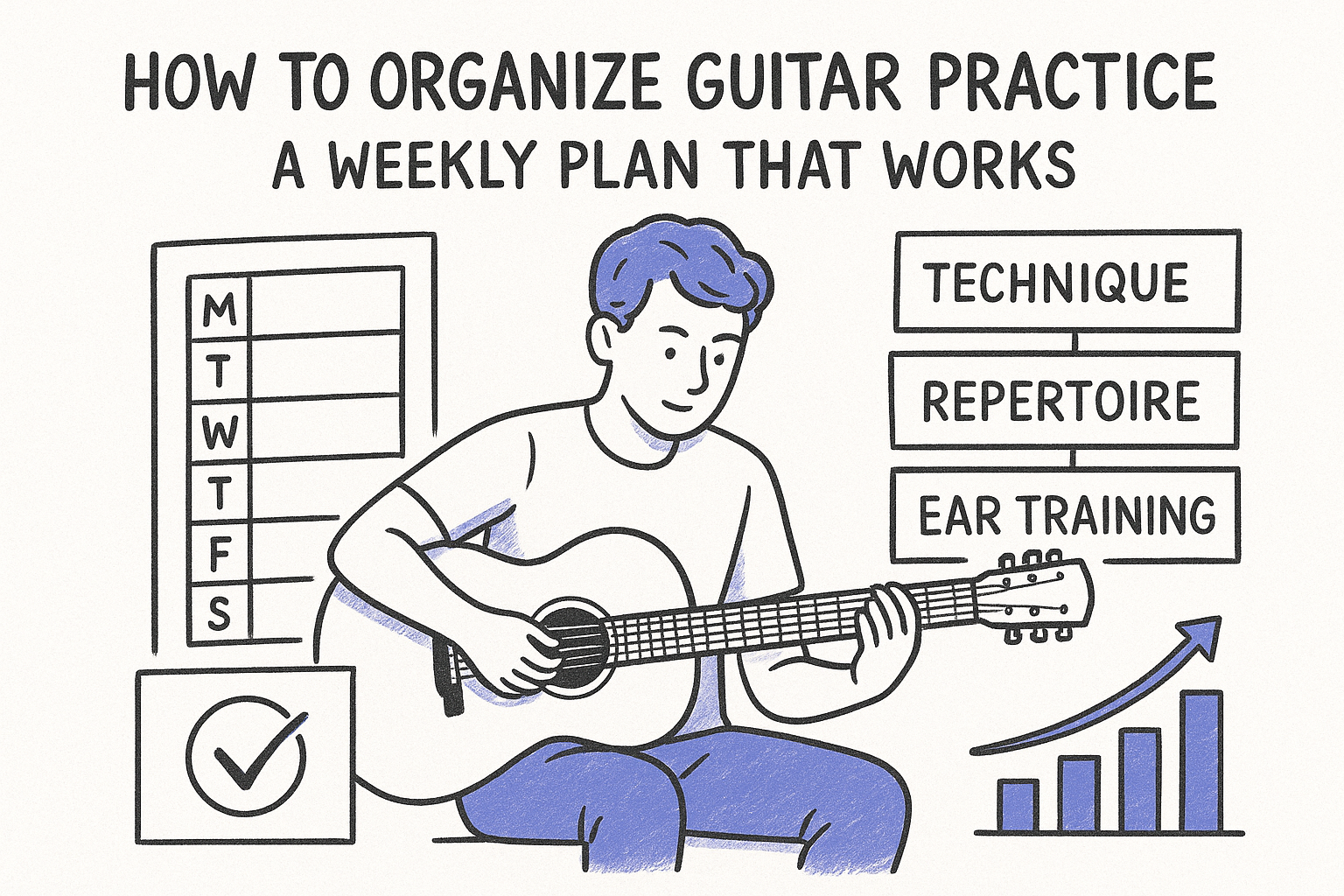
How To Organize Guitar Practice: A Weekly Plan That Works
You sit down to practice guitar, pick it up, and then… stare at it. Maybe you noodle around for a bit, revisit a riff you already know, or jump between exercises with no real direction. Sound familiar? The core issue isn't motivation, it's that most guitarists never learn how to organize guitar practice in a way that actually builds skill over time. Without a plan, you end up repeating what's comfortable and neglecting what needs work.
A good practice structure does two things: it tells you what to work on and when to revisit it. That second part is where most players fall short. You drill a tough chord transition on Monday, skip it for two weeks, and wonder why it feels brand new again. That's not a talent problem, it's a scheduling problem, and it's exactly the kind of thing spaced repetition tools like MemoRep are built to solve.
This guide gives you a concrete weekly plan for organizing your guitar practice, from splitting your time across technique, repertoire, and ear training, to deciding how often each skill deserves attention. By the end, you'll have a repeatable framework that keeps every part of your playing moving forward, not just the parts you enjoy most. Let's build it out, step by step.
What organized guitar practice actually means
Organized practice is not about practicing longer or harder. It means knowing exactly what you plan to work on before you pick up your guitar, and having a system that ensures every skill gets attention at the right frequency. Most guitarists operate on feel: they practice what's on their mind that day. The problem is that "what's on your mind" almost always skews toward what's already comfortable, which means the weak spots keep getting weaker.
The three core skill categories
When you think about how to organize guitar practice, start by splitting your playing into three broad categories. Each one builds a different part of your musicianship, and all three need time in your weekly plan.
| Category | What it includes | Why it matters |
|---|---|---|
| Technique | Scales, finger exercises, chord transitions, picking patterns | Builds the physical foundation your playing depends on |
| Repertoire | Songs, pieces, licks, and solos you're learning or maintaining | Applies technique in a musical context |
| Ear and theory | Interval recognition, chord identification, rhythm work | Connects what you hear to what you play |
Skipping any of these creates gaps. Heavy technique work with no repertoire leaves you with fast fingers and nothing to say. Repertoire-only practice is enjoyable but stalls your long-term development.
Why revisiting skills on a schedule matters
Learning a new skill in a single session does not make it stick. Your brain consolidates motor skills and muscle memory between sessions, not during them. If you nail a chord transition on Tuesday and don't touch it again for three weeks, you'll feel like you're starting over.
The fix is scheduling revisits before a skill fades, not after you've already forgotten it.
Spacing your practice across multiple sessions, with the right gaps between them, is what separates players who actually improve from players who feel like they're always starting from scratch. That's the real foundation of organized practice.
Step 1. Choose goals and a weekly time budget
Before you can plan anything, you need two numbers: what you're working toward and how many minutes per week you realistically have. These two pieces of information drive every other decision in how to organize guitar practice. Without them, you end up dividing your time randomly and stalling your own progress.
Set 1-3 specific goals
Vague goals like "get better at guitar" don't give you anything to schedule. Specific goals do. Pick one to three concrete targets for the next four to eight weeks, such as:
- Learn the intro riff to a specific song cleanly at 120 BPM
- Smooth out chord transitions between Am, F, C, and G
- Memorize the pentatonic minor scale in two positions
Keeping your goal list short forces you to prioritize deliberately rather than spread your attention thin across ten different things at once.
Decide your weekly time budget
Once you have your goals, total up the realistic practice minutes you can commit each week. Be honest with yourself. Five focused 20-minute sessions beats three 90-minute sessions you cancel half the time.
Consistent short sessions build skill faster than irregular long ones.
Use this as a starting template:
| Weekly time available | Suggested session length | Sessions per week |
|---|---|---|
| 60 minutes | 20 min | 3 |
| 150 minutes | 30 min | 5 |
| 210 minutes | 30-45 min | 5-6 |
Your total weekly budget now becomes the raw material you'll divide across skill categories in the next step.
Step 2. Build a repeatable session template
Once you know your time budget, the next step in how to organize guitar practice is building a session template you reuse every time you sit down. A template removes the decision-making from each session, so you spend your time playing instead of planning.
Structure your session in three blocks
Every session, regardless of length, should follow the same three-part structure: warm-up, focused work, and review. This order matters because each block serves a distinct purpose: warm-up primes your hands, focused work tackles new or difficult material, and review reinforces what you've already learned before it fades.
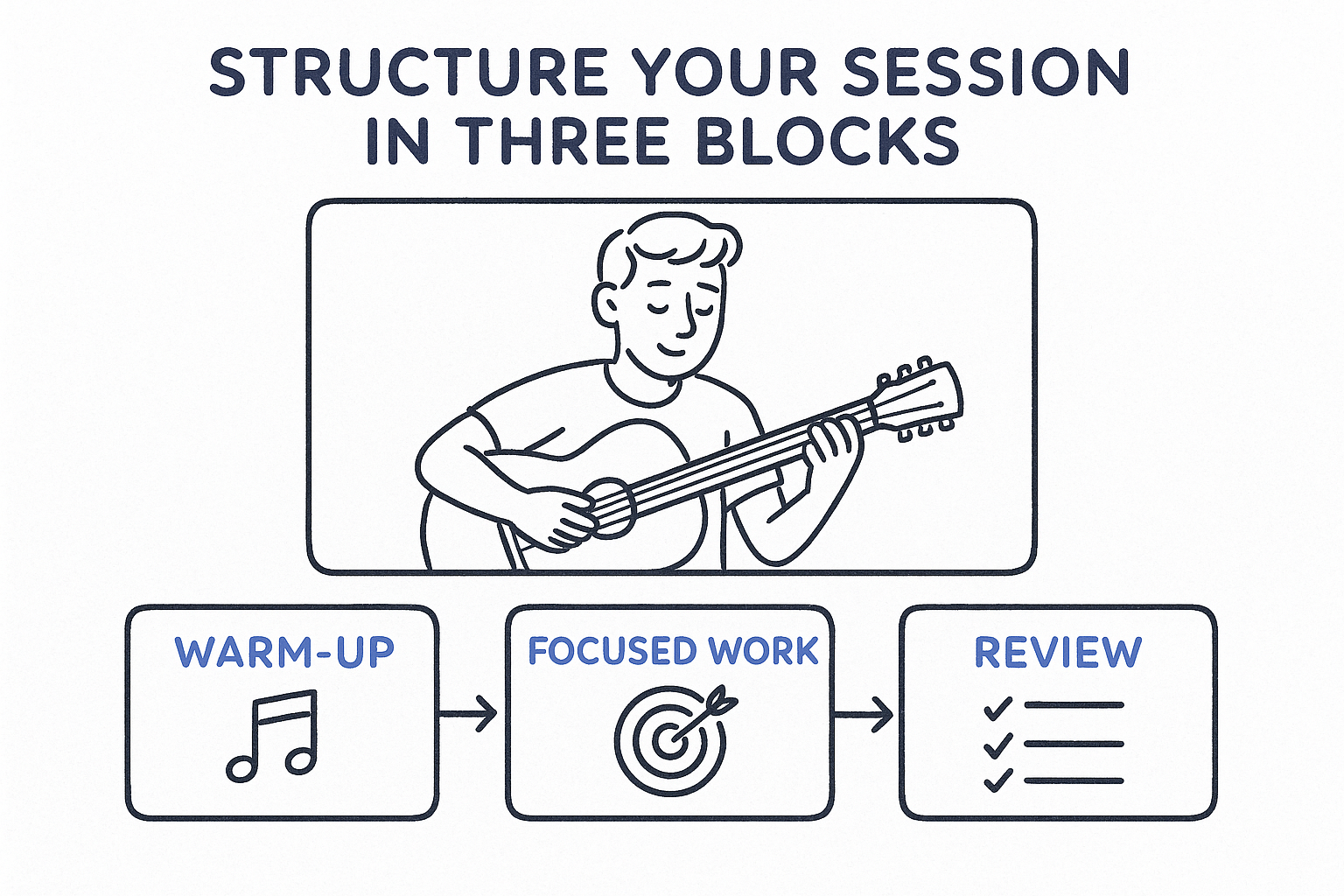
Skipping the review block is one of the fastest ways to lose skills you thought you had locked in.
Here's a template you can adapt to any session length:
| Block | 20-min session | 30-min session | 45-min session |
|---|---|---|---|
| Warm-up (scales, exercises) | 5 min | 5 min | 10 min |
| Focused work (current goals) | 10 min | 18 min | 25 min |
| Review (older skills) | 5 min | 7 min | 10 min |
Keep the template consistent
Changing the structure every session defeats the purpose. Repetition of the format is what makes it efficient, because your brain knows what's coming and you shift into practice mode faster. Adjust the time allocations as your goals evolve, but keep the three-block structure in place every time you practice.
Step 3. Plan your week with daily focus blocks
With your session template locked in, you can now map out a full week of practice. The key to how to organize guitar practice at the weekly level is assigning each session a primary focus area, so you're not trying to cover every skill category every single day. This keeps sessions tight and intentional, and removes the paralysis of deciding what matters most when you sit down.
Assign focus areas to specific days
Pick a primary category for each practice day from your three skill areas: technique, repertoire, and ear and theory. You don't have to ignore the others, but one category dominates the focused-work block. The warm-up and review blocks stay consistent regardless of the day's focus. Here's a five-day template you can adapt directly:
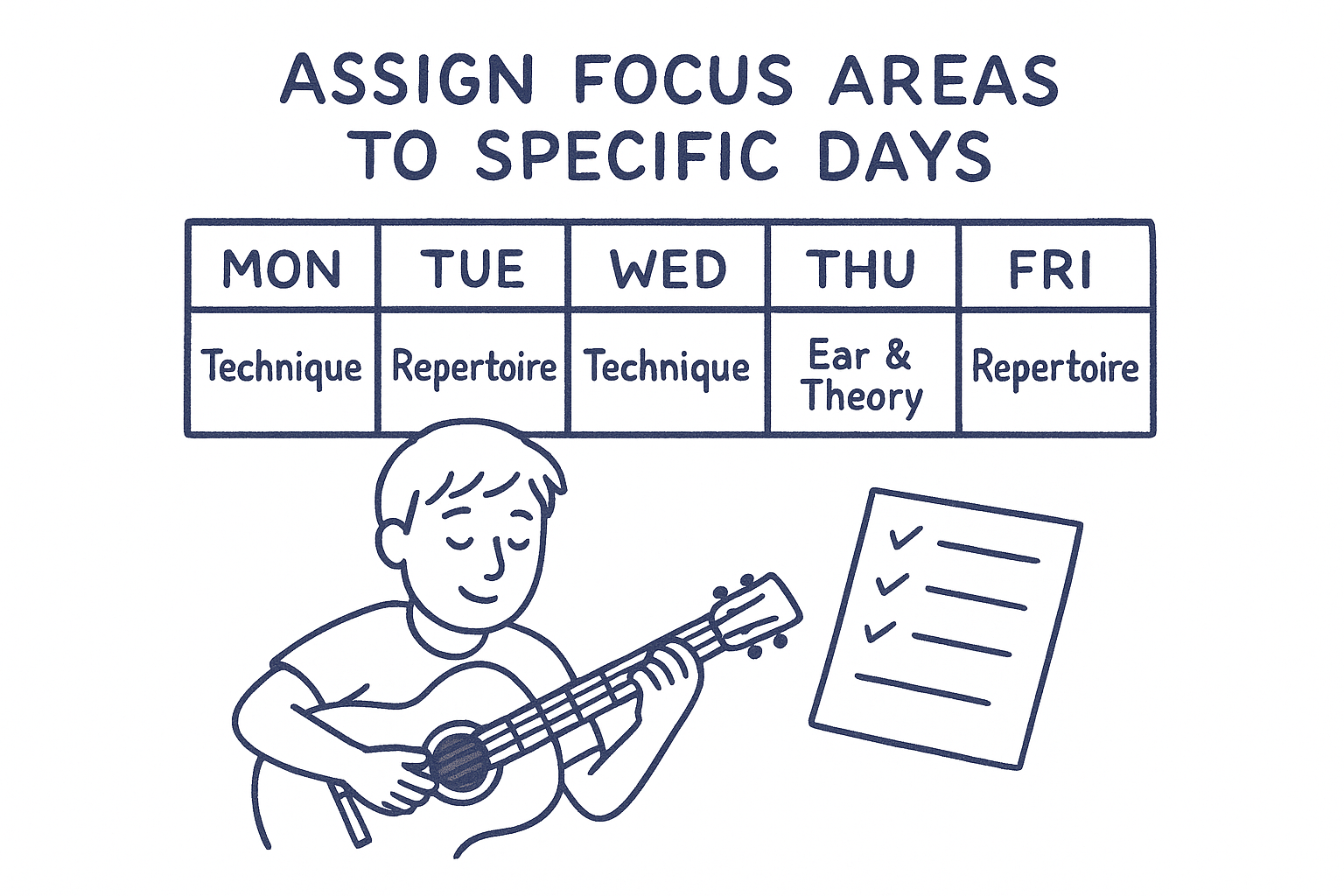
| Day | Primary Focus | Example Tasks |
|---|---|---|
| Monday | Technique | Scales, picking drills |
| Tuesday | Repertoire | Current song or riff |
| Wednesday | Technique | Chord transitions, exercises |
| Thursday | Ear and theory | Interval recognition, chord ID |
| Friday | Repertoire | Full run-through, problem spots |
Rotate to avoid repetition fatigue
Hitting the same skill category two days in a row occasionally is fine, but avoid stacking three or more consecutive sessions on only one area. Your hands and ears both need varied input across the week to properly consolidate what you've worked on.
Rotating focus areas keeps motivation higher and ensures your weak spots don't get ignored for days at a time.
Step 4. Track progress and adjust every week
A weekly plan only works if you review it regularly and make changes based on what's actually happening. Tracking progress is the part most guitarists skip, which is exactly why they repeat the same mistakes for months without noticing. Building a short weekly review habit closes that loop and keeps your plan useful instead of decorative.
Log what you practiced each session
After each session, spend two minutes noting what you worked on and how it felt. You don't need a complex system. A simple practice log with three columns covers everything you need:
| Session | What I practiced | How it went (1-5) |
|---|---|---|
| Monday | Pentatonic scale, position 1 | 3 - still shaky at tempo |
| Tuesday | Song intro riff | 4 - getting cleaner |
| Thursday | Chord transitions Am-F | 2 - needs more time |
Review and adjust at the end of each week
Set aside five minutes every Sunday to look at your log. Ask yourself two questions: which skills improved and which ones feel stuck? If something has stalled for two consecutive weeks, increase its frequency in next week's plan, swap a technique day for an extra repertoire session, or break the skill into smaller chunks.
Adjusting your plan based on real data is how to organize guitar practice in a way that keeps compounding over time.
Those weekly check-ins transform your plan from a static schedule into a living system that actually fits how you're progressing.
Next steps
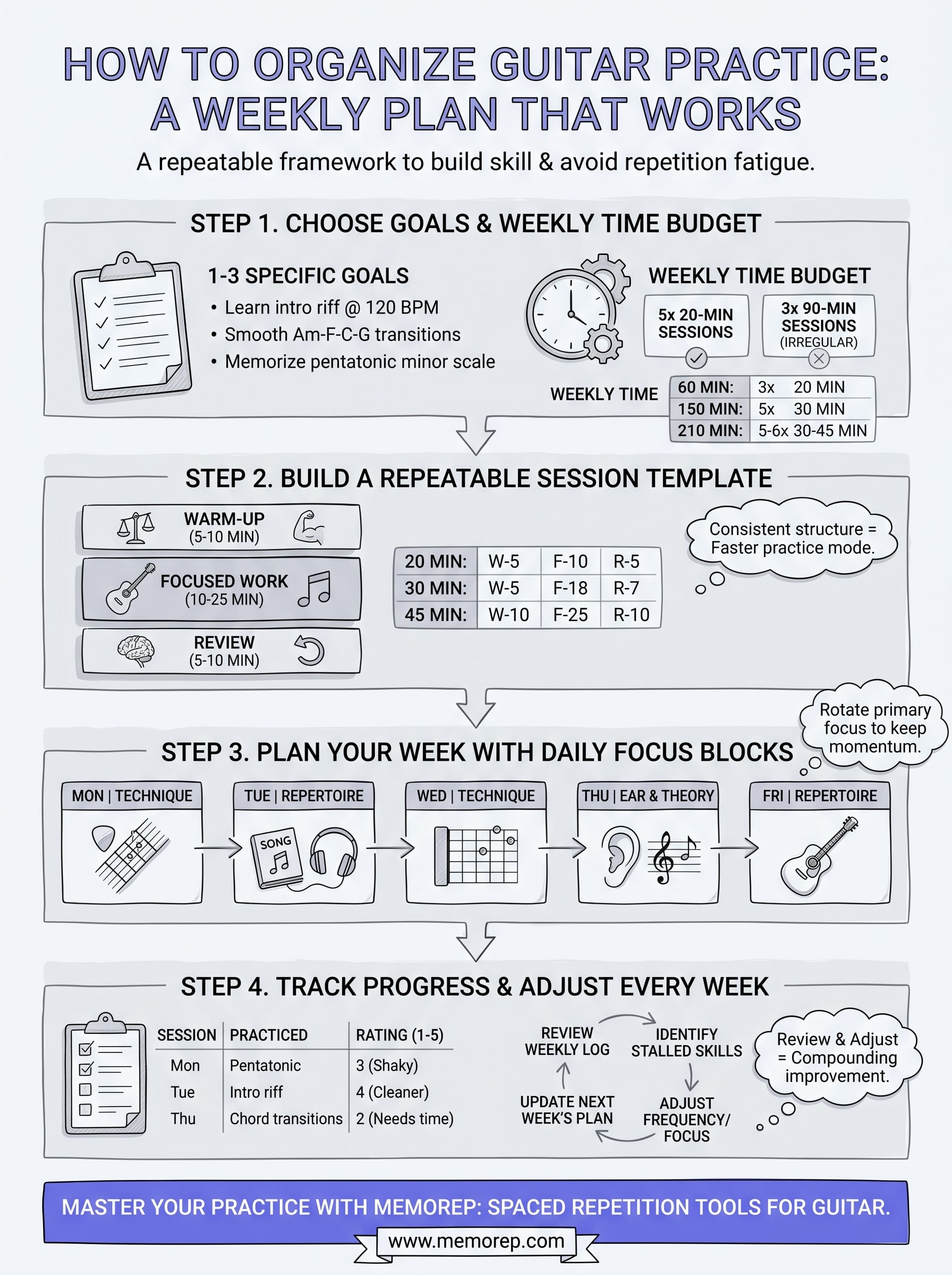
You now have everything you need to stop winging it and start practicing with real direction. The four-step framework in this guide, from setting goals and building a session template to planning weekly focus blocks and reviewing your progress, gives you a complete answer to how to organize guitar practice in a way that actually compounds over time.
The piece most players still miss after building a plan is consistent revisiting at the right intervals. Skills fade if you don't schedule them correctly, and tracking that manually is tedious. MemoRep uses spaced repetition to tell you exactly which skills to revisit and when, so nothing slips through the cracks. You build your practice cards once, and the algorithm handles the scheduling for you.
Start organizing your guitar practice with MemoRep and get free lifetime access while the beta program is still open.