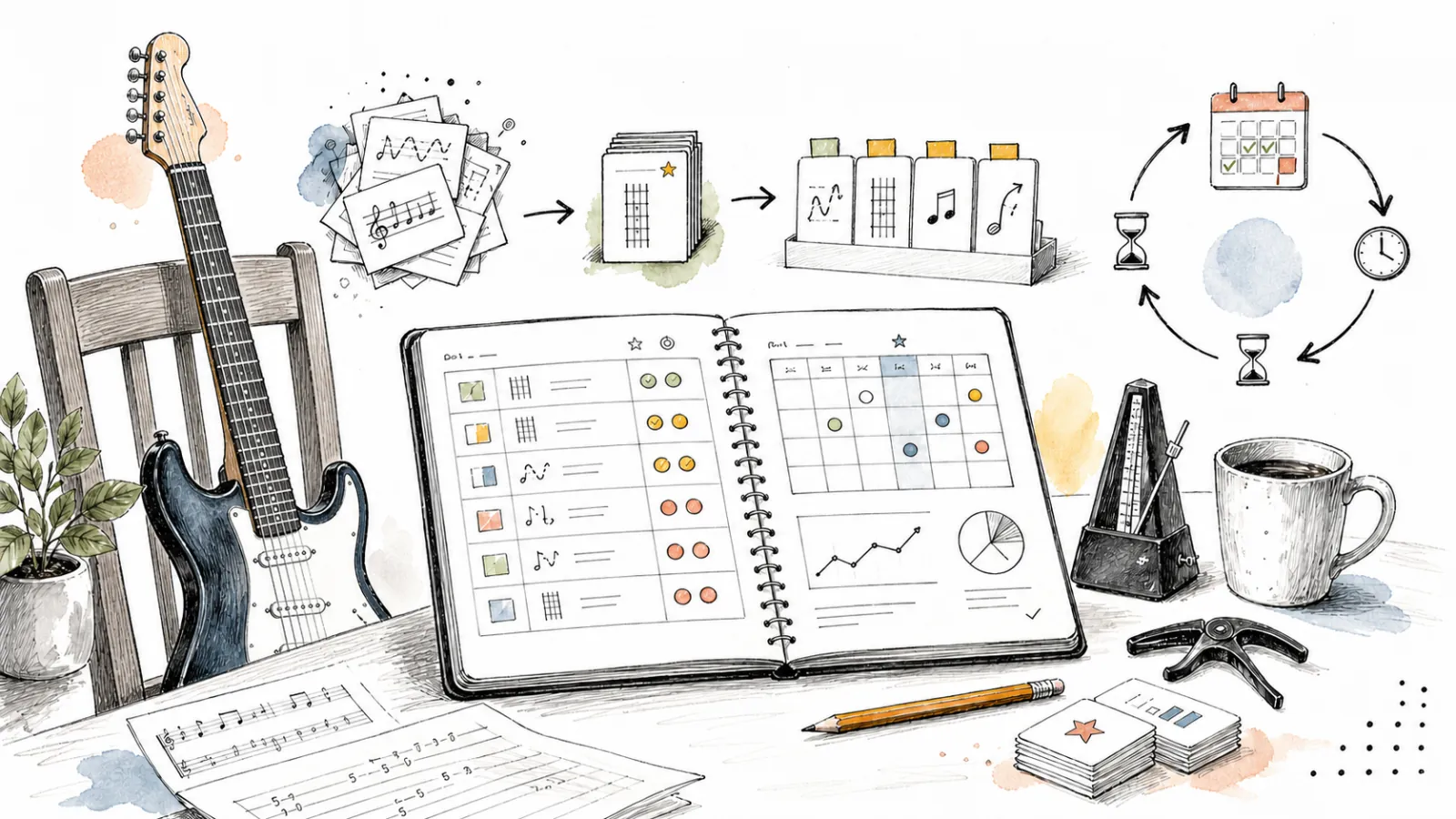

Build a Guitar Practice Planner That Actually Works
You sit down to practice, play a few scales, run a riff you almost had last week, drift into a song you already know, then spend the last part of the session wondering why your playing still feels stuck. Most guitarists don't have a motivation problem. They have a planning problem.
The usual fix is a notebook, a checklist, or a generic routine copied from a lesson video. That helps a little, but only until the list gets stale. Then you're back to guessing. A good guitar practice planner should do more than log time. It should tell you what matters today, what can wait, and what you're about to forget if you ignore it.
The difference between progress and repetition is structure. If you've ever learned something on Monday and felt it disappear by the weekend, this matters. A practice planner that adapts to your retention and weak spots turns random effort into reliable improvement.
Table of Contents
Why Your Guitar Progress Has Stalled
A lot of players think they're practicing because they're holding the guitar every day. That's not the same as training a skill. I've seen students spend serious time with the instrument and still feel like the same bends stay out of tune, the same transitions stay clumsy, and the same scale shapes vanish after a few days.
Usually the session looks productive from the outside. You warm up a little. You play what feels familiar. You touch something new. You chase whatever seems fun in the moment. Then a week later, the new material is shaky and the old material is slipping.

Noodling feels good, but it hides the problem
Unstructured playing gives you immediate enjoyment. It does not guarantee retention. That's why so many guitarists keep relearning the same material. They aren't lazy. They're relying on memory and mood instead of a system.
If that sounds familiar, the issue behind it is simple. Skills fade when you don't revisit them at the right time. That's the same pattern behind why players feel like they forget everything they learn.
Practical rule: If you keep “working on” the same thing for weeks, but it never becomes dependable under your fingers, your practice is too random.
Hours don't rescue a weak system
Many players miss the mark here. They assume the answer is more time. In practice, more time without structure usually means more drift. You end up doing extra repetitions of what you already like and avoiding the exact spots that need attention.
A real guitar practice planner fixes that by making choices in advance. It separates review from exploration. It keeps weak material from disappearing. It gives every session a job.
Here's what tends to stall progress fastest:
Repeating comfortable material because it sounds better right now
Practicing too many things at once so nothing gets enough focused reps
Treating every day the same even when some skills are stable and others are slipping
Ending sessions without notes so tomorrow starts from zero again
Playing guitar is not the same as practicing guitar. One is expression. The other is skill building.
When a player starts using a planner properly, the first improvement is rarely speed. It's clarity. They stop asking, “What should I work on?” and start asking, “Did I improve this card or not?” That shift changes everything.
From Vague Ambitions to Actionable Guitar Goals
Most practice plans fail before the first session starts. The player's goal is too broad. “Get better at lead guitar” sounds motivating, but it gives you nothing to execute today. You can't build a session around a slogan.
A useful goal points to a visible skill. It tells you what your hands should be able to do, under what condition, and how you'll judge success. That's what makes a guitar practice planner useful instead of decorative.
Bad goals sound inspiring and stay unusable
These are common:
Be more consistent
Improve improvisation
Clean up my technique
Learn the fretboard
There's nothing wrong with those as long-term aims. The problem is that they're too broad to schedule. If your target is fuzzy, your planner fills up with vague tasks and your practice cards become a mess.
Better goals produce clear practice items
Turn the broad aim into something you can train. For example:
Instead of improve bending, work on half-step bend accuracy on a specific string in a specific position.
Instead of learn pentatonics, drill one pentatonic pattern cleanly, then connect it to the next one.
Instead of get better at rhythm, practice one chord transition with one strumming pattern until it's stable.
A goal becomes actionable when you can answer these questions:
What exact skill am I training
What does success sound or feel like
What drill proves I'm improving
What belongs in review later
That last question matters more than most players realize. If a skill is worth learning, it's worth scheduling for future review. Otherwise you're building a revolving door where new material enters and old material leaves.
Use outcome goals and session goals together
A strong planner has two layers. The first is the bigger outcome, like mastering pentatonic patterns or cleaning up sweep picking. The second is the immediate task for today.
Here's a simple way to separate them:
| Long-term aim | Useful short-term goal |
|---|---|
| Play better blues solos | Connect one minor pentatonic pattern to one blues phrase cleanly |
| Improve left-hand technique | Drill one shift or stretch that breaks down in real playing |
| Learn CAGED | Memorize and play one shape fluently in context |
| Get cleaner alternate picking | Fix one string-crossing pattern that causes tension |
The best goals reduce friction. You should be able to look at one card and know exactly what to play.
A good rule is this. If one goal contains several unrelated subskills, split it. “Work on scales” is too broad. “A minor pentatonic box one ascending and descending cleanly” is usable. “Intervals over scale shapes” is a project. “Thirds across one scale pattern” is a card.
That distinction keeps your planner honest. It stops you from pretending a huge subject is one task. It also makes progress easier to see, which matters on the days when practice feels slow.
Organize Your Practice with Projects and Cards
Most guitarists don't need more motivation. They need better containers. When your planner is organized badly, everything becomes one giant topic called “technique,” “lead guitar,” or “songs.” That structure kills focus because it hides the actual work.
The simplest fix is to organize your practice library into Projects and Cards.
A Project is one focused skill area. A Card is one drill, one pattern, one phrase, one movement, or one problem inside that area. That's the level where practice becomes manageable.

Build projects around real skill families
Good project names are specific enough to hold related drills without becoming a junk drawer. Examples:
Pentatonic Scale Patterns
CAGED Patterns
Bend Techniques
Left Hand Drills
Sweep Picking
Interval Patterns Over Scales
Those work because each project has a single identity. You know what belongs there and what doesn't.
The most common planning mistake is creating a project that's too broad. “Technique” sounds neat, but it's useless in daily practice. It mixes picking, fretting, bends, slides, muting, timing, and more into one pile.
For building the actual cards, the thinking is similar to creating narrow, trainable prompts. The same principle behind effective memory cards applies here. One card should represent one clear action.
Good vs. bad practice project structure
| Vague (Bad) | Focused (Good) |
|---|---|
| Technique | Bend Techniques |
| Scales | Pentatonic Scale Patterns |
| Lead Guitar | CAGED Patterns |
| Picking | Sweep Picking |
| Fretboard | Interval Patterns Over Scales |
| Practice Songs | Chorus riff of one song, intro rhythm of one song, solo phrase of one song |
Cards should be playable, not academic
A card isn't a topic. It's a task. If the card says “Pentatonics,” that's not a task. If it says “Pattern one in A, ascending and descending cleanly,” now you have something you can review.
Good card examples:
Half-step bends on the G string
C-shape major chord pattern
One sweep picking shape across a fixed string set
Position shift inside a pentatonic pattern
Call and response lick in one key
Bad card examples:
Blues
Improvisation
Guitar technique
Music theory for solos
Coach's shortcut: If a card needs a paragraph to explain it, split it into smaller cards.
A structured planner also matters because your review library grows fast. One modern guitar planning framework describes practice as spending roughly 90% of time on review and warmup and only 10% on breaking new ground within a session, according to the Hal Leonard Guitar Practice Planner. That only works if your material is organized well enough to revisit without confusion.
What works better than one giant list
When players separate skills into focused projects, three things improve immediately:
Selection gets faster because today's work is easier to identify
Review gets cleaner because old material stays grouped by skill
Weak spots show up sooner because broad labels no longer hide them
That's the structure I'd trust with real students. Small projects. Narrow cards. Clear actions. No junk drawer categories.
How to Schedule Reviews with Spaced Repetition
A static practice plan looks efficient on paper. Monday scales, Tuesday chords, Wednesday lead, Thursday songs. The problem is that your hands don't forget on a calendar. They forget based on how well you learned something, how long it's been, and how shaky the skill was in the first place.
That's why fixed checklists stop working. They treat every skill as equally stable. They're not.

Review timing decides whether skills stick
The strongest planner answers one daily question for you. What is due now? Not what sounds fun. Not what you practiced most recently. What is ready for review before it drops off.
That's the practical value of spaced repetition. You revisit a skill when it's becoming fragile, not after it's already gone. For guitar, that matters even more than in pure memorization because physical skills decay subtly. A bend can feel fine in isolation and still fall apart in a phrase a few days later.
If you want the background behind the timing model, the core idea is covered well in this explanation of spaced repetition science.
Static balance is not the same as smart balance
A lot of guitar advice pushes “balanced” practice. A little technique, a little repertoire, a little creativity. That sounds sensible, but it can become wasteful if it ignores performance quality.
A better system shifts time toward what is weak, error-prone, or recently forgotten. That's the more useful reading of modern planning advice. As discussed in this feedback-driven guitar practice discussion, many guitar practice guides recommend fixed routines, but the stronger systems use your performance to decide what to practice next.
The best review schedule is not the fairest one. It is the one that protects weak skills before they disappear.
What an adaptive planner does differently
Instead of repeating the same template every day, an adaptive planner works like this:
You learn a card
You review it later
You rate how it went
The next review changes based on that result
If a drill felt unstable, it returns sooner. If it felt easy and accurate, it moves further out. That's what makes the system efficient. You don't waste review time on material that's already solid, and you don't lose gains on material that still needs reinforcement.
Here's the practical contrast:
| Static routine | Adaptive routine |
|---|---|
| Reviews the same categories on fixed days | Reviews due skills based on performance |
| Gives equal space to strong and weak material | Shifts attention toward weaker material |
| Relies on memory to decide what's slipping | Uses review history and ratings |
| Feels organized at first | Stays useful longer |
This approach also solves one of the biggest sources of wasted practice time. Decision fatigue. When your queue only shows due material, you stop burning mental energy deciding whether today should be bends, rhythm, or scale linking. The planner has already done that sorting.
Building Your Daily Practice Habit
A planner only works if it fits a real session. Most players don't need a heroic schedule. They need one they can repeat. A practical benchmark is to plan 45–50 minutes of focused work when you have a 1-hour window available, and split the session into 10–20 minute segments, as recommended in this guitar practice routine guide. That structure keeps attention sharp and gives each block a job.
Here's what that looks like in daily use.

Start with the due queue
Open your planner and look at what's due. That list should contain review cards, not a random collection of interests. With such a list, a session becomes calm. You're not deciding from scratch. You're executing.
A simple flow works well:
Warm up first with easy movements that wake up both hands
Review due cards next while focus is high
Add one new card only if you have enough attention left
Finish with application through a riff, song section, or improvisation
That pattern is sustainable because review comes first. New material stays controlled instead of swallowing the whole session.
Use ratings to drive tomorrow
The key step comes after each card. Rate it. However your system labels it, the logic should be simple: failed, hard, solid, easy. That one judgment drives the next interval.
If you skip the rating, you lose the adaptive part of the planner. Then you're back to a static log. The rating is what tells the system whether this bend drill needs quick reinforcement or whether this CAGED shape can wait.
A practice session is not finished when the guitar goes back on the stand. It's finished when you've recorded how each skill performed.
A clean example of a daily session
This is a practical template:
Warm-up block
Use easy finger exercises, basic scale motion, and relaxed picking.Review block
Work through due cards from existing projects such as pentatonic patterns, bend control, or left-hand drills.New skill block
Add one fresh card from your current project. Keep it narrow.Creative block
Apply the day's material in a backing track, riff context, or short jam.
What doesn't work is trying to push several new concepts in one sitting. The planner should reduce overload, not formalize it.
Tracking Progress and Staying Consistent
The most misleading metric in guitar practice is time. Time matters, but it doesn't tell you whether a skill got cleaner, more accurate, or more stable under pressure. A useful guitar practice planner tracks performance, not just minutes.
That means your notes should stay close to the actual problem. Was the bend in tune. Did the shift happen cleanly. Did the pattern fall apart when the string crossing changed. Those observations are more useful than “practiced scales today.”
Track quality before speed
One of the best practical standards for skill acquisition is to aim for 5–7 correct repetitions in a row after you make an adjustment or fix an error, as recommended in this structured guitar practice plan. That keeps the focus on clean execution instead of rushing ahead.
Useful things to track on a card:
Accuracy notes such as where the phrase breaks
Tension signals in the picking hand, fretting hand, or shoulders
Metronome context if tempo is part of the task
Success condition such as clean transition, controlled tone, or reliable articulation
Consistency comes from smaller wins
Players quit systems when they expect every session to feel impressive. That's not how skill building works. Some days your review queue will feel easy. Some days the same cards feel stubborn. Neither day is a problem if you keep logging honest feedback.
A few habits keep the planner working long term:
Keep projects narrow so your review list stays meaningful
Accept hard days because difficult ratings are useful data
Retire cards that are stable so the library stays clean
Split muddy cards quickly when one item hides several problems
Progress often looks boring before it looks impressive.
The guitarists who improve most reliably aren't always the ones who push hardest. They're the ones who keep a clear loop running. Practice. Rate. Review. Repeat. That loop beats random intensity every time.
If you want a system that schedules practical guitar skills instead of just logging sessions, memoRep is built for that. You can organize focused projects like pentatonic patterns, bend techniques, CAGED shapes, or left-hand drills, then use practice cards and reminders to review each skill when it's due. That makes weekly setup faster, cuts guesswork, and helps you spend less time deciding what to practice and more time keeping real playing skills sharp.